
E2E Test Suite: Tiers, Folders, and CI
This is a contributor-facing manual for the e2e/ test suite's tier structure — why it exists, how it's organized, which flags/labels control it, and how to work with it locally.
Why this exists
Before this restructuring, every PR ran the entire e2e suite — every diagram, every theme variant, every look/handdrawn combination — on every push. That's thorough, but it's expensive in two ways that scale badly as the suite grows:
- CI time. A full run takes significantly longer than most PRs actually need. Most changes touch one diagram type; waiting on a full 8-shard run to validate a one-line fix is slow feedback for no real benefit.
- Argos quota. Every full run captures and uploads a screenshot for every diagram fixture, whether or not that fixture has anything to do with the change under review. Visual-regression services bill (or rate-limit) by build/screenshot volume, so an oversized "safety net" run on every push burns through quota fast.
The fix is to split fixtures and specs into tiers — a small, fast, curated set that runs on every PR by default, and larger, slower sets reserved for less frequent, higher-confidence checks (nightly, and before a release-bound merge).
Measured impact (from a real before/after comparison on this fork, on 2026-09-24 — pulled directly from GitHub Actions run history for PR #7; treat this as a dated example, not a live-updating stat):
| Full suite (pre-tiering) | pr-check-tier only | |
|---|---|---|
| Shards | 8 | 2 |
| Per-shard time | ~15–18 min | ~6–8 min |
| Total wall-clock | ~31 min | ~8 min |
| Total compute (shard-minutes) | ~128 | ~14 |
Roughly a 4x reduction in wall-clock time and ~90% less total CI compute for the common case — a PR that only needs the pr-check tier to validate its change. That tracks with the underlying fixture split: as of 2026-09-24, pr-check covered about 15% of all .mmd fixtures (312 of 2,136 — nightly-check held 1,375, visual-check held 449). These counts will grow over time; the proportions are the durable part.
Directory layout
Two parallel trees hold the suite's content:
Code:
flowchart TD
  subgraph diagrams["e2e/diagrams/<diagram-type>/"]
    direction LR
    d_pr["pr-check/<br/>*.mmd fixtures"]
    d_nightly["nightly-check/<br/>*.mmd fixtures"]
    d_visual["visual-check/<br/>*.mmd fixtures"]
  end
  subgraph rendering["e2e/rendering/<diagram-type>/"]
    direction LR
    r_pr["pr-check/<br/>*.spec.ts"]
    r_nightly["nightly-check/<br/>*.spec.ts"]
    r_visual["visual-check/<br/>*.spec.ts"]
  end
  runner["e2e/rendering/mmd-snapshots.spec.ts<br/>(global fixture runner)"]
  diagrams -->|discovered & rendered by| runner
e2e/diagrams/<diagram-type>/<tier>/*.mmd— static Mermaid source fixtures. Each one is just a diagram (optionally with YAML frontmatter settingconfig/title/adescription). They aren't run directly; a single global spec,e2e/rendering/mmd-snapshots.spec.ts, discovers every.mmdfile undere2e/diagrams/, registers one Playwright test per fixture (grouped intodescribeblocks mirroring the folder path), and renders it. This is where the large majority of diagram-rendering coverage lives — no test-writing required, just add a.mmdfile in the right tier folder.e2e/rendering/<diagram-type>/<tier>/*.spec.{js,ts}— hand-written Playwright specs, for anything a static fixture can't express: DOM/CSS assertions,.click()interactions, directive-vs-initialize()precedence checks, multi-diagram array tests, custommermaid.initialize()config, and similar. If your test needs to assert on rendered output beyond "did it render without erroring," it belongs here instead of as a fixture.e2e/other/<tier>/*.spec.{js,ts}— cross-cutting specs that aren't about any single diagram type (XSS/security tests, GHSA regression tests,iife/embed tests, page-interaction tests, external-diagram loading). Onlypr-check/is populated today.e2e/helpers/— shared test infrastructure:util.ts(theimgSnapshotTest/renderGraph/verifyScreenshothelpers every spec uses) andmmd-snapshots.ts(fixture discovery/metadata for the global runner).
Not every <diagram-type>/<tier>/ directory has content yet — some are intentionally empty, left in place as containers for tests that haven't been written. An empty tier folder isn't stray or safe to delete; it's scaffolding for the layout above, matching a diagram type or tier that's expected to gain coverage later.
The three tiers
| Tier | Intent | Runs on |
|---|---|---|
pr-check | Small, curated, fast smoke set — one or two representative fixtures per feature, not an exhaustive sweep. | Every PR (see below), plus a develop merge, plus every nightly run. |
nightly-check | Bulk/comprehensive coverage — most of the fixture volume lives here. | Once every 24h, plus a master-bound PR/merge (alongside pr-check). |
visual-check | Theme/look (classic/neo/handDrawn)/layout/direction combinatorial sweeps — the same diagram rendered across every variant. Pixel/appearance content, not parse-only. | Not part of any automated CI gate. Reviewed manually via Applitools as a release-process step (e2e-applitools.yml, workflow_dispatch-only). |
A fixture or spec's tier is purely a function of which subfolder it lives in — there's no separate registry or config file to update.
If you're new to this structure, here's how to decide where a new test belongs:
- Adding a new diagram feature or syntax? Add one small
pr-checkfixture covering the happy path — this is what every PR runs, so it catches an obvious regression immediately. If the feature has several meaningfully different shapes/variants/edge cases worth covering, add those as additional fixtures undernightly-checkinstead of piling them all intopr-check—pr-checkis meant to stay small and fast, not become exhaustive. - Fixing a rendering bug? Add a
pr-checkfixture that reproduces the bug (the minimal diagram that triggered it), so this exact regression is caught on every future PR. Only drop it intonightly-checkinstead if it's a narrow, rarely-hit edge case where running it on every PR isn't worth the extra time. - Backfilling broad coverage for something that already works (e.g. every node-shape × edge-type combination, a sweep of config options)? That bulk volume belongs in
nightly-check— it's comprehensive by design and only needs to run once a day, not on every push. - Testing a purely visual/appearance difference — how a diagram looks under a different theme,
handDrawnlook, layout direction, or similar, where the underlying structure/parsing is unaffected? That'svisual-check. It's pixel/appearance content reviewed by a human via Applitools, not something an automated parse-only assertion can usefully judge. - Does your test need to assert on something beyond "did it render without erroring"? — a DOM/CSS assertion, a
.click()interaction, directive-vs-initialize()precedence, a multi-diagram array, custommermaid.initialize()config — that can't be expressed as a static.mmdfixture. Write a hand-written spec instead, undere2e/rendering/<diagram-type>/<tier>/*.spec.{js,ts}if it's about one specific diagram type, ore2e/other/<tier>/*.spec.{js,ts}if it's cross-cutting (security/XSS, embed/iife, page interactions, external-diagram loading, and similar). The same tier logic above still applies to these — a fast smoke-test spec goes inpr-check, a more exhaustive one innightly-check.
When in doubt, default to pr-check for anything a feature's author would want caught immediately, and move broader/slower coverage to nightly-check.
How CI decides what to run
Code:
flowchart TD
  start{"What triggered this run?"}
  start -->|"PR → develop"| pr_label{"'run pr tests'<br/>label set?"}
  start -->|"PR → master"| release_label{"'run release test'<br/>label set?"}
  start -->|"Push to develop<br/>(e.g. a PR merge)"| push_develop["pr-check tier only"]
  start -->|"Push to master"| push_master["pr-check + nightly-check tiers"]
  start -->|"Scheduled (daily) or<br/>manual 'simulated nightly'"| nightly_run["pr-check + nightly-check tiers"]

  pr_label -->|yes, or PR just opened| pr_scoped["pr-check tier only"]
  pr_label -->|no| blocked1["e2e skipped —<br/>required check fails"]

  release_label -->|yes, or PR just opened| gated["pr-check + nightly-check tiers<br/>(visual-check excluded — see Applitools)"]
  release_label -->|no| blocked2["e2e skipped —<br/>required check fails"]
Both labels — run pr tests and run release test — default to on: a small automation job adds them to every freshly-opened PR (targeting develop and master respectively). Removing the label before a later push causes e2e to be skipped for that push, which is treated as a failure of the required status check (not a silent pass) — merging is still possible via a repo admin's branch-protection bypass, but it's not a default-open door.
Note that run release test — despite its name — does not gate the visual-check tier. visual-check is theme/look/layout/direction combinatorial sweeps: pixel/appearance content that's better judged by a human during the manual Applitools pass (e2e-applitools.yml) than by an automated parse-only check here. The label name is a holdover from before this tier split; renaming it is tracked separately and out of scope for this doc.
This label-gating logic, and the nightly/scheduled workflow, are upstream-only — every branch of this logic is guarded by a check that it's running on mermaid-js/mermaid, not a fork. On a fork, e2e.yml falls back to its original full-suite/diff-based-scoping behavior, and the nightly workflow's own job is a no-op (there's no Argos project/credentials there to make screenshot capture worthwhile).
Flags and environment variables
| Name | Where | Effect |
|---|---|---|
MERMAID_E2E_FIXTURE_TIER | env var, read by mmd-snapshots.spec.ts | Comma-separated tier list (e.g. pr-check, or pr-check,nightly-check) that narrows which .mmd fixtures get registered. Unset = every tier. |
run pr tests | GitHub PR label | Gates whether a develop-bound PR's e2e run happens at all (scoped to pr-check tier when present). Defaults on for new PRs. |
run release test | GitHub PR label | Same, for master-bound PRs (scoped to pr-check+nightly-check — visual-check excluded, see above). Defaults on for new PRs. |
E2E_SCOPE_BY_DIAGRAM | repo variable | Kill-switch for the (separate, older) diagram-diff-based scoping used outside the tier-gating paths. Set to 'false' to force the full suite unconditionally. |
RUN_VISUAL_TEST | computed CI env var | Controls whether screenshots get captured for Argos upload. Only ever true on the real upstream repo — never on this fork. |
USE_APPLI | env var | Switches screenshot verification to Applitools instead of the Argos/local-snapshot path. Common in personal dev shells — remember to override it (USE_APPLI=) when you specifically want the Argos code path locally. |
SCREENSHOT_DIR | env var | Overrides where Argos-mode screenshots get written locally. Defaults to e2e/screenshots. |
GROUP_ARGOS_IMAGES / group_argos_images | computed CI env var / workflow_dispatch input | Whether screenshots get composited into per-folder "sheets" before Argos upload, versus uploaded individually. |
MERMAID_DEV_EXPLORER_ROOT | env var, read by .esbuild/server.ts | Which .mmd root the local Dev Explorer (/dev route) serves. Defaults to e2e (the whole tree — fixtures, platform diagrams, everything). |
MERMAID_PORT / MERMAID_DEV_PORT | env var | Overrides the dev server port Playwright/the dev server use. |
E2E_COVERAGE | env var | Switches the dev server to the coverage-instrumented build, and enables native V8 coverage collection during a Playwright run. |
Working with tiers locally
Run only the pr-check tier (mirrors what a PR's CI actually runs):
MERMAID_E2E_FIXTURE_TIER=pr-check pnpm exec playwright test e2e/rendering/mmd-snapshots.spec.ts $(node scripts/e2e-tier-scope.mjs pr-check | tr ',' ' ')Run a "simulated nightly" (pr-check+nightly-check) without waiting for the schedule:
gh workflow run "Nightly E2E" --repo mermaid-js/mermaid
# or purely locally, no CI involved:
MERMAID_E2E_FIXTURE_TIER=pr-check,nightly-check pnpm exec playwright test e2e/rendering/mmd-snapshots.spec.ts $(node scripts/e2e-tier-scope.mjs pr-check nightly-check | tr ',' ' ')
See what a fixture would look like in Argos, without needing real Argos credentials or touching any baseline: capture screenshots locally with RUN_VISUAL_TEST=true (remembering to clear USE_APPLI if it's set in your shell), then either browse e2e/screenshots/ directly, or run pnpm run screenshots:sheets to composite them the same way CI does before upload.
Run a release test against Applitools: start the local dev server first (pnpm dev, in its own terminal) — the suite is large enough that it's worth having it already warm rather than waiting on Playwright's own webServer auto-start/cold build on the first request. Neither of these is something you'd run as part of routine local development — they're only used when preparing a release:
# Core release check: pr-check + nightly-check tiers, against the "release-baseline" Applitools branch.
pnpm playwright:release-test

# Extended release check: the visual-check tier (theme/look/layout combinatorial sweeps),
# against its own separate "release-baseline-extended" Applitools branch.
pnpm playwright:release-test:extended
Both scripts set USE_APPLI=true, so every screenshot is verified against Applitools instead of the Argos/local-snapshot path, and both pin APPLITOOLS_BRANCH to a fixed, long-lived branch name rather than letting the SDK derive one from the current git branch — so re-running either script, from whatever branch you're on, keeps comparing against the same accumulated baseline. The two scripts use separate baseline branches deliberately: the core and extended checks differ enough in scope and cadence that mixing both into one branch would make the Applitools review history harder to read.
Diagrams and screenshots
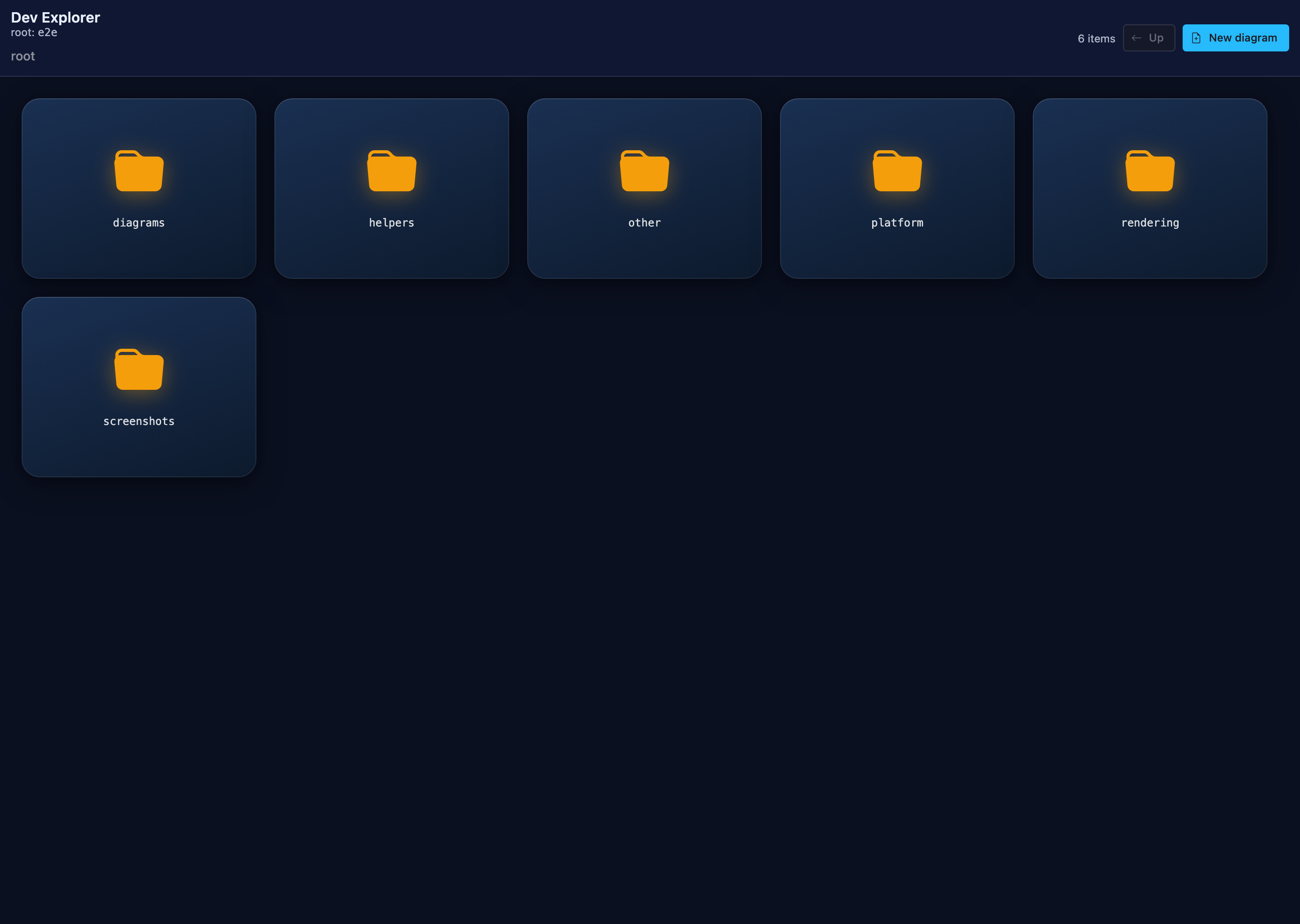
The Dev Explorer (/dev route) — browse .mmd fixtures under the configured MERMAID_DEV_EXPLORER_ROOT and preview them rendered:
📸 Placeholder — add screenshots here:
- The GitHub PR "Checks" tab, side by side: a
develop-bound PR showing the scoped 2-shardpr-check-tier run, versus amaster-bound PR showing the scoped 4-shardpr-check+nightly-checkrun (visual-checkexcluded).- The "Nightly E2E" entry in the Actions tab, filtered, showing a recent scheduled run's result.
The flowcharts above (directory layout, CI decision flow) are Mermaid diagrams — edit them the same way you'd edit any diagram in this repo. If you add more diagrams to this doc, prefer Mermaid over static images where the content is structural/flow-based (it stays accurate as the suite evolves, and — fittingly for this repo — is easy for any contributor to update in a plain-text diff).